History blog19 October 2012
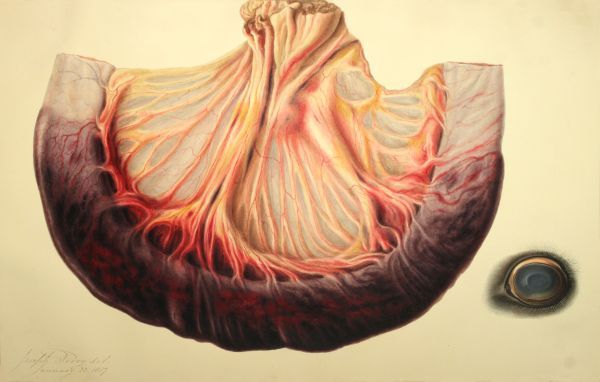
The beautiful botanical illustration which you may have seen in an earlier post is the work of Jean-Pierre Megnin.
It forms part of a collection of material by Megnin, which includes books, manuscripts, drawings and engravings, which the Royal College of Veterinary Surgeons acquired in the 1980s.
Jean-Pierre Megnin (1828-1905) graduated from Alfort Veterinary School in 1853 and served in the French army from 1860 until his retirement in 1885. Retiring from the army he founded the journal L’Eleveur (The Breeder).
Throughout his life Megnin wrote articles and books on a wide variety of subjects (his main interests were parasitology and skin conditions in domesticated animals) illustrating most of them himself. There are many examples of his skilled draughtsmanship in our collections.
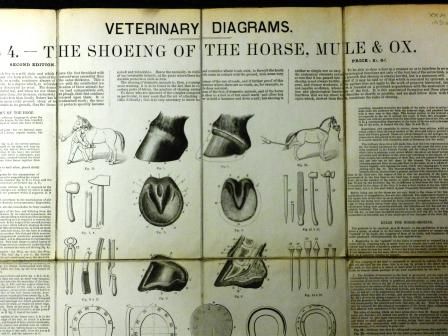
In 1872 and 1873 he produced a set of posters, on topics such as ‘the age of domestic animals’, ‘the unsoundness and defects of the horses’ and ‘the shoeing of the horse, mule and ox’ which were sold mounted on cloth and folded (as the ones in our collection are) or mounted on a roller. They were published in the UK as Veterinary Diagrams in tabular form with the text translated in to English (probably by George Fleming) but unfortunately Megnin was never acknowledged as the illustrator.
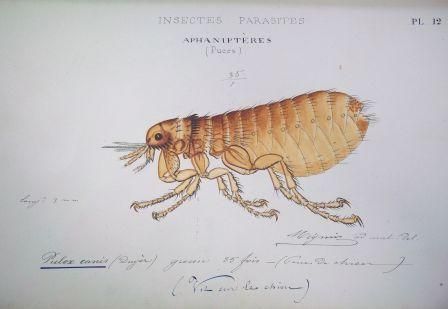
Other examples of his illustrations can be found in our books on parasitology. The Pulex Canis, shown here drawn in great detail, is from Megnin’s Atlas: iconographie des insectes parasites de l’homme et des animaux domestiques Paris, 1869
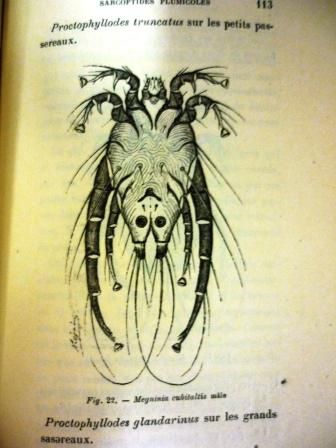
And there is this illustration of a species of feather mite – the Megninia Cubitalis, which Megnin discovered in 1877, in Les acariens parasites. Paris: Gauthier-Villars c1892.
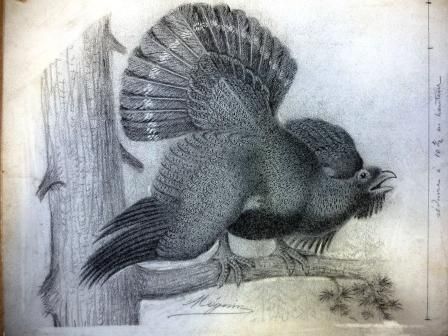
Amongst a series of ornithological drawings we have this fearsome looking bird – is it a Capercaillie?
As well as his illustrations Megnin is also known for his work and papers on forensic entomology. The most significant of his papers was later published as La Faune des Cadavres, Application de l’Entomologie à la Médecine légale.
Whilst we don’t have a copy of this we are fortunate to have Megnin’s handwritten notebook titled Memoire sur l’application de l’entomologie a la medecine legale au point de vue des questions de l’identite des cadavers [Account of the application of entomology to legal medicine from the point of view of the question of the identity of cadavers] which is dated 1884.
A 100 years later in 1986 Kenneth Smith dedicated his book A manual of forensic entomology to Megnin and two others (Marcel LeClercq and Pekka Nuorteva) describing them as ‘Pioneers in the application of entomology in forensic science’ so the work, as well as the illustrations, of this pioneering Honorary Associate of the RCVS still lives on.
Read more history blogs
-
History blog
 26 August 2026
International Dog Day 2026
-
History blog
-
History blog
 8 June 2026
Open Farm Sunday