History blog24 September 2013
Recently there has been another of those coincidences that those of us who work in libraries love. Two quite separate enquiries which end up having something – or in this case someone – in common.
The first enquiry was from a researcher who wanted to look at The quarterly journal of veterinary science in India and army animal management and the second from someone who was researching James McCall, founder of Glasgow Veterinary College.
The connection? John Henry Steel – who was the co-founder of the journal and who had a medal named after him which was awarded to McCall in 1899.
As is usual when this happens curiosity got the better of me and I had to find out more.
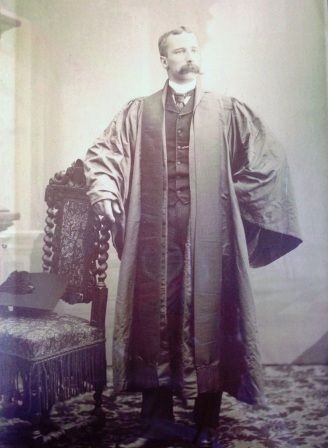
John Henry Steel
John Henry Steel FRCVS (1855-1891) followed his father into the veterinary profession, graduating from the London Veterinary College in 1875. After a brief spell in the army he took up a post as Demonstrator of Anatomy at the London College where he remained for five years, before resigning when the professorship, which he had been promised, was abolished.
He re-entered the army and, in 1882, went to serve in India, which was to be the scene of his most notable achievements. Upon arrival, he “was immediately impressed by the utter want, outside the Army, of anything approaching Veterinary Science” and set about rectifying the situation.
One of his first moves was to establish, in 1883, The quarterly journal of veterinary science in India and army animal management. This journal, which he co-founded with Frederick Smith, allowed vets to share information and record progress in treatments etc.
Secondly, in 1886, he established a veterinary college in Bombay so that the population could be “educated in veterinary matters”.
Sadly the severe mental and physical strain of running the journal and the College took its toll and he was taken ill, returning to England in 1888. Against the advice of doctors, he went back to India after a few months and involved himself fully in the life of Bombay, taking up the reins at the College again and becoming a Fellow of the University and a JP.
His health did not improve and, seemingly aware of his imminent death, he wrote an editorial for the journal, dated October 1890, titled ‘Cui Bono’ (to whose benefit?). It starts:
“To every conscientious worker there arrive times of introspection when the questions arise to him what has been the outcome of my efforts?”
Steel then proceeds to assess his life’s work and in particular to question the usefulness of the Journal and whether it was worth the “at times laborious work”.
He feels
“it has succeeded in enlarging the mind of the public and profession on matters veterinary…[and has] enabled men working on the same subjects… to co-ordinate their work and results”
and if at all possible it must continue
“Considering how things were before the Quarterly, considering the work our Journal has been enabled to do…we have decided to continue its production”
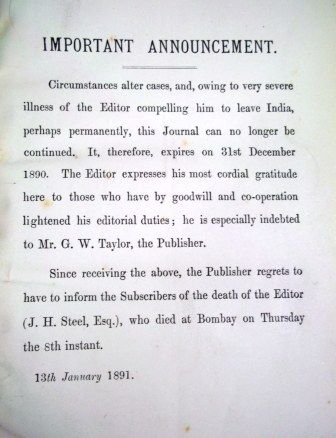
Announcement of closure of journal
Sadly this was not to be and Steel wrote an announcement stating that owing to severe illness he was having to leave India and that the Journal will no longer be continued after December 1890. The publisher then adds to the end of the announcement, which was distributed with the last issue, “J H Steel, Esq …died at Bombay on Thursday the 8th”.
He was just short of his 36th birthday.
The three page obituary in the Veterinary Record (31 January 1891), from which the title of this post is taken, and the fact that the RCVS instituted a medal in his honour testifies to the high regard in which he was held by the profession.
The College which he founded, the Journal and his books on diseases of the ox, dog, elephant, sheep, and camel and on equine relapsing fever remain as his lasting legacy.
Read more history blogs
-
History blog
 26 August 2026
International Dog Day 2026
-
History blog
-
History blog
 8 June 2026
Open Farm Sunday