History blog5 July 2018
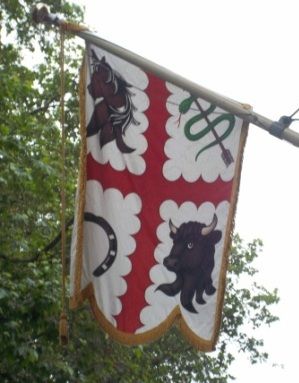
On RCVS Day – the day of our Annual General Meeting and Presentation of Awards – the College flag is usually flown on Belgravia House.
The flag displays the College arms which were granted in July 1844.
The official description in the Grant of Arms is:
“Arms: argent, a cross engrailed gules between a horse’s head erased in the first quarter; an arrow in bend, entwined by and piercing a serpent in the second; a horseshoe in the third, all proper; and a bull’s head erased sable in the fourth.
“Crest: on a wreath of the colours, a centaur proper, holding a shield argent, charged with aloe, also proper.
“Motto: vis unita fortior.”
So what does all that mean?
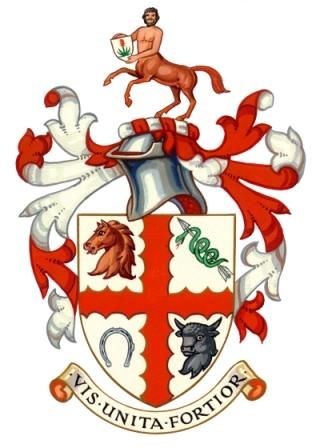
In simpler terms:
The arms are a red cross with a wavy outside border on a white shield. The four quarters show a horse’s head, an arrow piercing a serpent, a horseshoe and a bull’s head.
The heads of the horse and bull are ‘erased’, ie torn from the body. The arrow ‘in bend’ runs diagonally top right to bottom left when viewed from the back of the shield. ‘Proper’ indicates natural colouring.
The horse, bull and horseshoe were all included to represent branches of the veterinary art, while the healing arrow pierces the serpent of disease.
The white background indicates purity, and the red cross, self-sacrifice.
The centaur on the crest is presumed to represent Chiron the centaur, the Greek mythological ‘father’ of all medicine. The centaur has been used by many veterinary organisations as their emblem.
“Vis unita fortior” or “In unity lies strength” was not original. It had been the motto of William Harvey, who discovered the circulation of blood in 1628. It was also adopted by the Veterinary Medical Association when it was reconstituted in 1836.
Read more history blogs
-
History blog
 26 August 2026
International Dog Day 2026
-
History blog
-
History blog
 8 June 2026
Open Farm Sunday