History blog21 December 2011
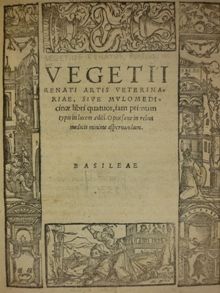
The earliest specific veterinary book in the Collection, and the first ever published, is Artis veterinariae, sive mulomedicinae libri quatuor, which was published by Faber in Basle in 1528.
There is also an English translation of this work in the Historical Collection which was published in London in 1748 by A. Millar. Its title is “Vegetius Renatus, of the distempers of horses and of the art of curing them; as also of the diseases of oxen, and of the remedies proper for them; and of the best method to preserve them in health, and restore them when sick, and to prevent the spreading and communication of infectious distempers, according to the practice of the ancient Romans.”
Artis veterinariae, sive mulomedicinae libri quatuor which translates as “The veterinary art; that is to say animal medication in four books” was written by Publius Vegetius Renatus around 450-500 AD. Divided into four books it refers to a wide range of cattle and equine diseases under the general term “malleus” giving cures based on contemporary beliefs.
In the English translation the cure for “the bite of a mad dog” is given as follows:
“Burn the place that is bitten with Iron-cauteries, or which is better, with those made of copper, and put him in a dark place … that he may not see water…..if you can kill the mad dog himself, you shall boil his liver ….. and give it to [the afflicted animal or person] to eat… it will be of special benefit, if you dig up the root of the herb they call dog-rose… and apply it to Man or Beast which a mad dog has bit… For by this method alone he will not b affected with an Hydrophoby, and will escape imminent danger.”
Other cures given include those for dysentery, jaundice, distemper, swellings in the legs, inflation in the belly and scorpion stings.
Vegetius, Renatus (1528) Artis veterinariae, sive mulomedicinae libri quatuor. Basle: Ioannes Faber Emmeus Juliacensis (18905-1001).
You can now read this book online, the English translation is also online here.
To view this, or any other book in the Historical Collection, please contact us at library@rcvsknowledge.org to arrange an appointment.
Read more history blogs
-
History blog
 26 August 2026
International Dog Day 2026
-
History blog
-
History blog
 8 June 2026
Open Farm Sunday