History blog30 January 2012
‘We embarked on Friday 10th November, but owing to bad weather did not leave L/pool [Liverpool] until 12.30 noon on 12th November’
so reads an entry in a small notebook which is part of one of the treasures of our archives – the Sir Frederick Smith Collection.
Smith sailed for South Africa on the 12 November 1899 with the 13th Hussars aboard the S.S. Templemore. This little book is his record of the veterinary care he gave on board as well as in later operations in Natal including the Battle of Colenso, Vaal Krantz and Brakfontein.
In his book A veterinary history of the war in South Africa Smith describes two ways in which horses were transported overseas – they were either carried with the troops on transport ships or they went on board freight ships.
He states that animals conveyed in freight ships suffered ‘a great disadvantage,’ when compared to those on transport ships, as they were accompanied by less experienced men who had many more horses in their care. So the horses on board the SS Templemore could be classed as lucky!
Two days into the voyage, on 14th November, the entry in the notebook records the first fatalities like this ’C127 strangulation, found dead, C57 staggers, died, C118 staggers, died in 2 hours’. It is not clear what C127 etc refers to – perhaps it refers to the location of the horse on the ship or it may be the number attached to the horse by the army.
Over the course of the 4 weeks of the voyage the notebook records a total of 12 deaths and numerous conditions from which the horses recovered. The only entry for 28th November records Smith’s own sickness – ‘I was ill in bed all day’.
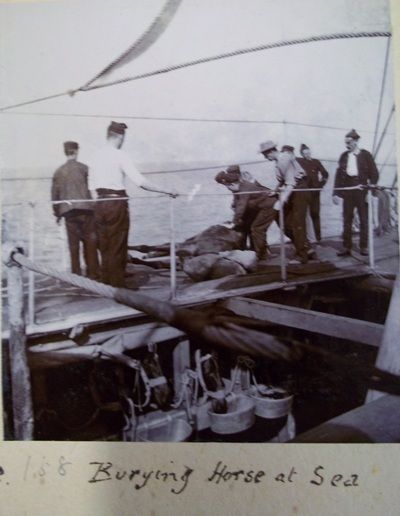
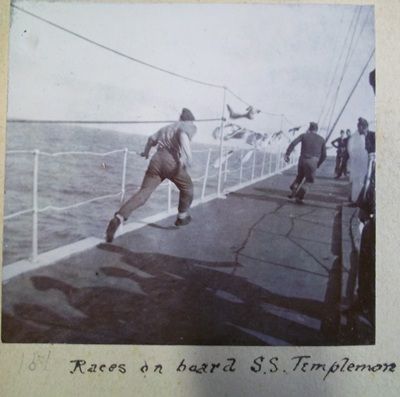
We also have an album of photos in the Smith Collection which contains a number taken on board the SS Templemore. These include a photo of a horse being buried at sea, a rather dark image of some animals on the horse deck, and some more light hearted images of the troops keeping fit by racing each other around the ship and doing exercises as part of their physical drill.
If you can shed light on what C127 etc means do let us know.
Reference
Smith, Frederick (1919) A veterinary history of the war in South Africa 1899-1902 London H. & W. Brown
Images: photographs from the album in the Smith Collection
Read more history blogs
-
History blog
 26 August 2026
International Dog Day 2026
-
History blog
-
History blog
 8 June 2026
Open Farm Sunday