What is quality improvement (QI)?
Quality improvement (QI) in veterinary practice is a structured but practical way to make care better. It helps teams understand what’s working well, what could be improved, and how to make meaningful changes. By using QI techniques and applying a learning mindset, QI fosters continuous development and collaboration to improve outcomes for animals, clients and the veterinary team.
QI and the veterinary professions
Quality improvement (QI) is well suited to the veterinary professions. It has its roots in the aviation and manufacturing industries, where safety is also critical and performance can have a major impact on people’s lives.
QI emphasises the importance of teams, which is one of the top reasons veterinary professionals stay in their jobs.1,2 It acknowledges that many people are involved in delivering top-quality outcomes, and that everyone can play a part in making things better.
Key QI concepts and tools
Quality improvement (QI) is based on the concepts of open, collaborative, systematic and continuous working. These apply to all QI tools and techniques, several of which are related. For example, you can use the results of an audit to help you write guidelines for your practice. The diagram in figure 1 explains how these tools and techniques are related.
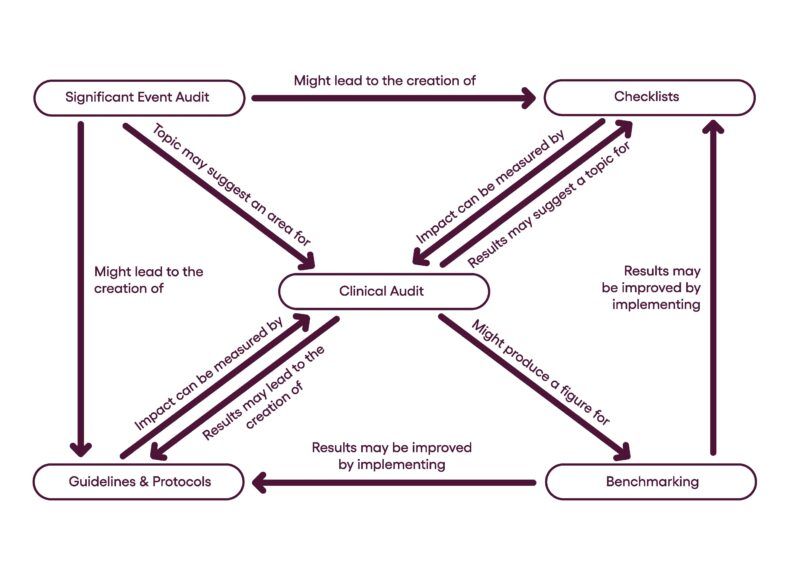
The most common tools include:
- audit: a process for monitoring and assessing clinical care to identify areas for improvement and take action based on your findings
- checklist: a system to try to reduce errors
- benchmarking: structured comparisons of your own outcomes over time, or of your outcomes in comparison with your peers
- guidelines: guidance for treating specific conditions to support decision-making
- protocol: a set of instructions, usually for a situation where there is a known outcome.
Benefits of QI
Adopting quality improvement can help veterinary teams to:
- prevent avoidable harm to patients
- improve patient-centred care
- monitor, maintain and enhance clinical standards
- improve team efficiency and workflow
- identify better practice
- embed evidence-based veterinary medicine
- enhance client relationships and concordance
- improve communication
- develop a united team
- foster a learning culture
- progress professionally
- enjoy work.
Who QI is for
QI is for everyone in the veterinary team. Whatever your role, you can use QI to nurture, develop, and enhance an area of practice. Work with a colleague and tackle a focus area together or encourage your team to choose different areas to develop, then come together to share ideas and learn from each other.
Whether you’re building on an existing interest or addressing a challenge that’s been identified in practice, QI gives you the tools to make meaningful change. Start small, stay curious, and be the change that drives better outcomes for your patients, clients and team.
References
- Hagen JR, Weller R, Mair TS, Kinnison T. Investigation of factors affecting recruitment and retention in the UK veterinary profession. Veterinary Record. 2020;187(9):354
- Hagen JR, Weller R, Mair TS, Batt-Williams S, Kinnison T. Survey investigating factors affecting recruitment and retention in the UK veterinary nursing profession. Veterinary Record. 2022;191(12):e2078
If practices are proactive in letting their clients know that they’re always looking for ways to improve procedures, I think clients would be very grateful for that and expect that nowadays.”